
Hagia Sophia: Witness to Empires
A Guided History Exploration for Independent Learners
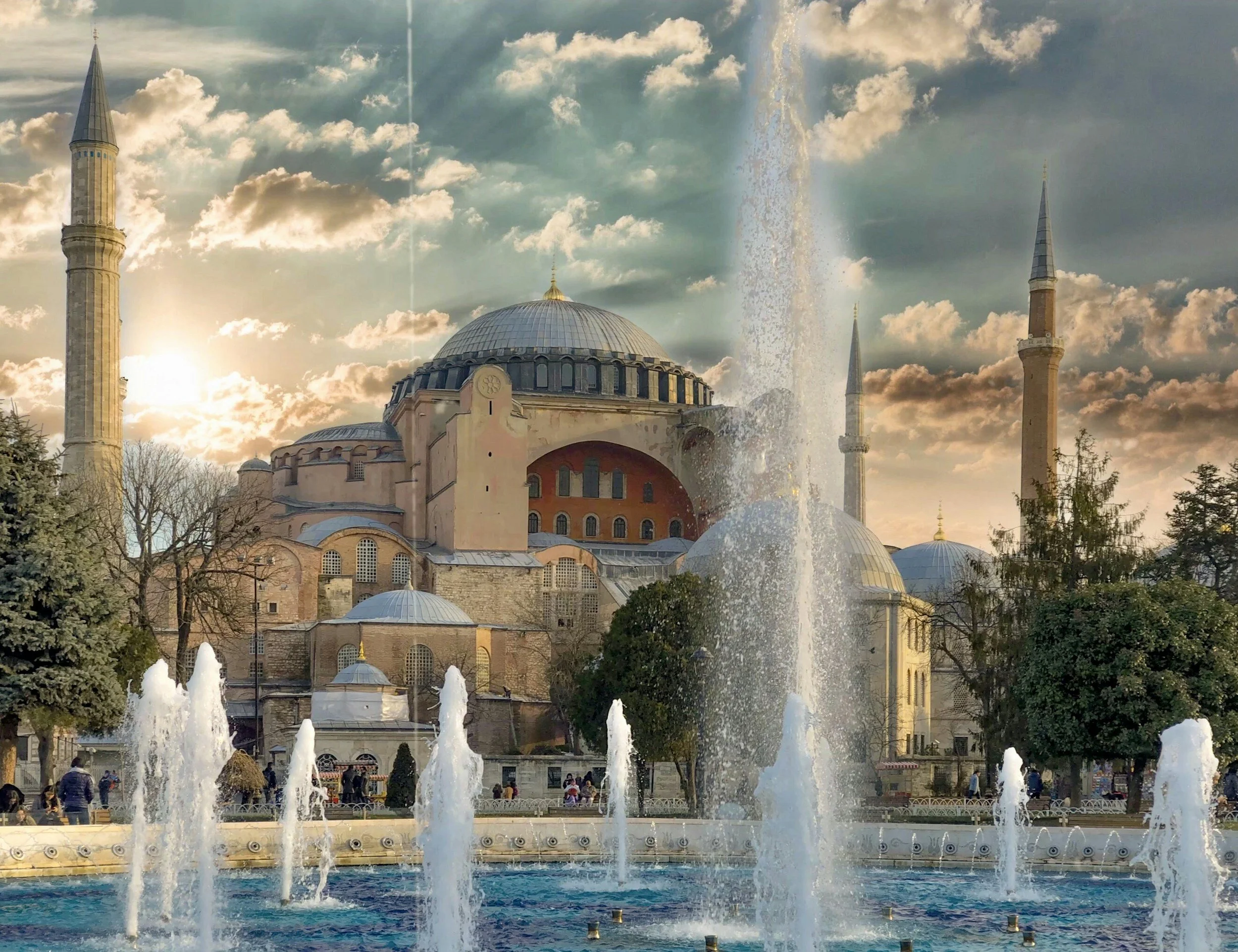
Hagia Sophia has been a cathedral, a mosque, and a museum. Each era left its mark, in the dome, the mosaics, the calligraphy, and the stonework. This study asks students to read those marks carefully.
Through historical narrative, art analysis, and reflective writing, students examine how the building was constructed, how its decoration shifted as power changed hands, and what it means for one sacred space to hold that many layers of history.
Designed for independent learners ages 12–15.
Instant Digital Download
Student Guide + Teacher’s Guide + Printer-Friendly Version
Complete Bundle - $15
Who is This Guide For?
Homeschool families · Middle school world history · Islamic studies programs · Art & architecture studies · Humanities enrichment
—————————— What You’ll Get ——————————
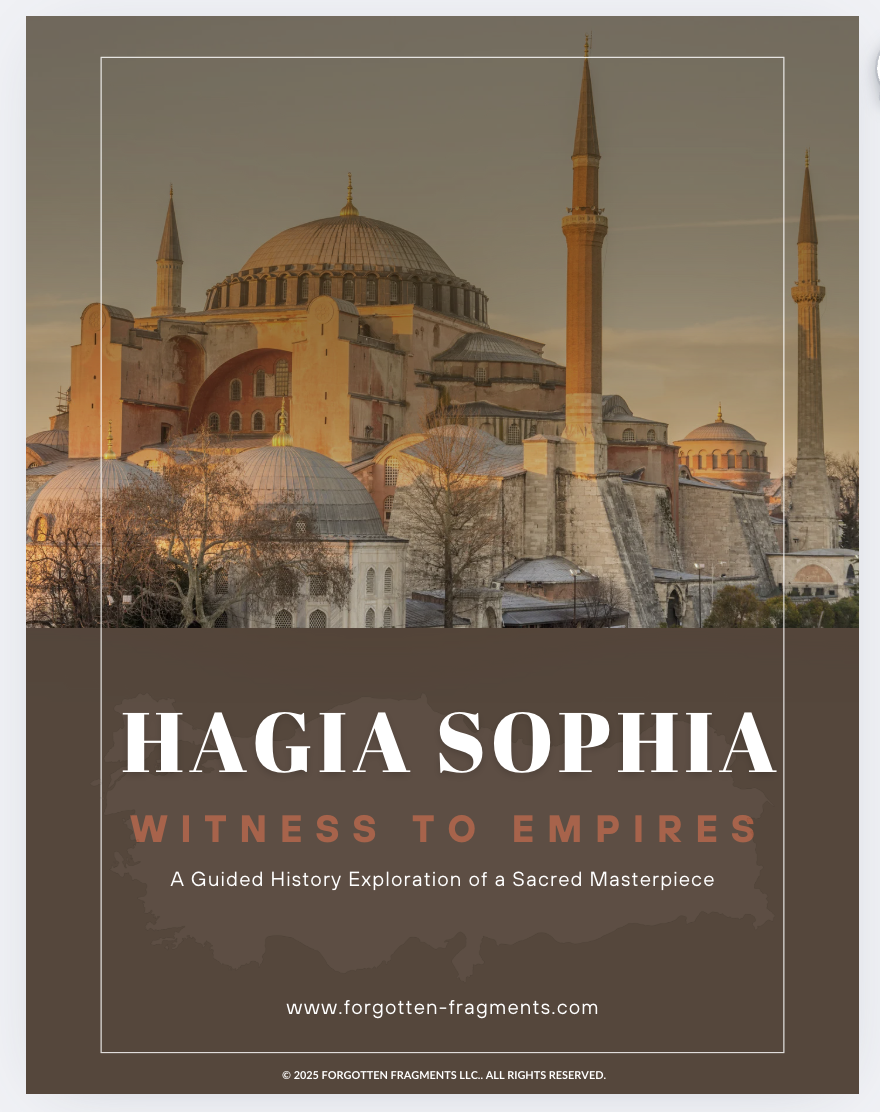
A five-lesson history and architecture study designed to be completed independently. Through historical narrative, art analysis, and reflective writing, students explore how one sacred space reflects the beliefs, politics, and culture of different civilizations across nearly 1,700 years.
Rather than memorizing facts, students analyze:
Why empires build the way they do
How belief shapes sacred space
What happens when civilizations inherit one another's monuments
The study ends with a capstone project that synthesizes history, architecture, faith, and cultural meaning.
How to use in your homeschool or co-op:
1–2 week unit
Humanities architecture study
World religions & history block
Co-op discussion unit
Included with your purchase:
Student Guide (Digital Download) PDF
Detailed Teacher’s Guide
Printer-Friendly Student Guide
Justinian’s architectural revolution
Anthemius & Isidore
Dome engineering & earthquakes
Collapse and rebuilding of the dome
Light, acoustics & sacred space
Gold mosaics & Iconoclasm
Lesson Descriptions
Lesson 1: Byzantium and the Origins of Hagia Sophia
Students begin with the geography. They ask why this particular location, at the meeting point of Europe and Asia, became one of the most contested and significant sites in the ancient world. From there they move into the story of how a city became an empire, and how an empire decided to build something that had never been built before.
Strategic geography of the Bosphorus
Greek Byzantium & Roman Constantinople
Constantine’s vision for “New Rome”
Rise of the Byzantine Christian Empire
The Nika Riots & destruction of the original cathedral
Lesson Activity: Students step into the role of Constantine’s lead scout, compare three possible capital sites, and write a formal recommendation to the emperor.
Lesson 2: Byzantine Architecture & Art
The dome of Hagia Sophia shouldn't have been possible. This lesson looks at how it was built anyway: the engineering problems, the solutions, the collapses, the rebuilding, and then turns to what the building was meant to say. How did Byzantine architects use light, proportion, and mosaic to express theology? What were they trying to make people feel when they walked inside?
Lesson Activity: Students conduct a close visual analysis of Hagia Sophia’s most significant Byzantine mosaics to uncover how art was used to express faith, power, and theological meaning in the empire.
Lesson 4: The Modern Era — Museum and Mosque
Lesson Activity: Students reflect on the meaning of sacred space by writing from multiple historical perspectives and evaluating whether a place of worship can retain its spiritual purpose when secularized.
Lesson 3: Middle Ages & Ottoman Transformation
In 1204, crusaders sacked Constantinople and stripped Hagia Sophia of everything valuable. In 1453, the Ottomans conquered the city, and Mehmed II walked straight to the building. What he did next is one of the most studied moments in the history of sacred space. He preserved it, converted it, and built on top of it. This lesson asks students to understand why and what that decision reveals about how civilizations treat what they inherit.
Fourth Crusade & desecration (1204)
1453 Ottoman conquest
Preservation & conversion under Mehmed II
Mihrab, minbar & minarets
Concealment (not destruction) of mosaics
Cultural synthesis of Byzantine & Islamic traditions
Life of the mosque as spiritual & civic center
Lesson Activity: Students research either Mimar Sinan’s architectural legacy or Ottoman Islamic art in Hagia Sophia and create an interpretive written or visual explanation of how meaning was layered onto the building.
In 1935, Atatürk turned Hagia Sophia into a museum. In 2020, Turkey converted it back into a mosque. Both decisions were political as much as religious and both caused global controversy. This lesson asks students to sit with the complexity of that. Who owns a sacred space? What happens when a building means different things to different people at the same time?
Secularization under Mustafa Kemal Atatürk
Museum era (1935–2020)
2020 reconversion into a mosque
UNESCO designation
Tensions between universal heritage & living worship
Lesson 5: Capstone Project — Layers of Meaning
After moving through 1,700 years of history, students are asked to make sense of it. What does Hagia Sophia mean, and who gets to decide? Students choose between a formal analytical essay or a creative visual presentation to argue their interpretation of how the building's layered past shapes its meaning today.
Preview Pages
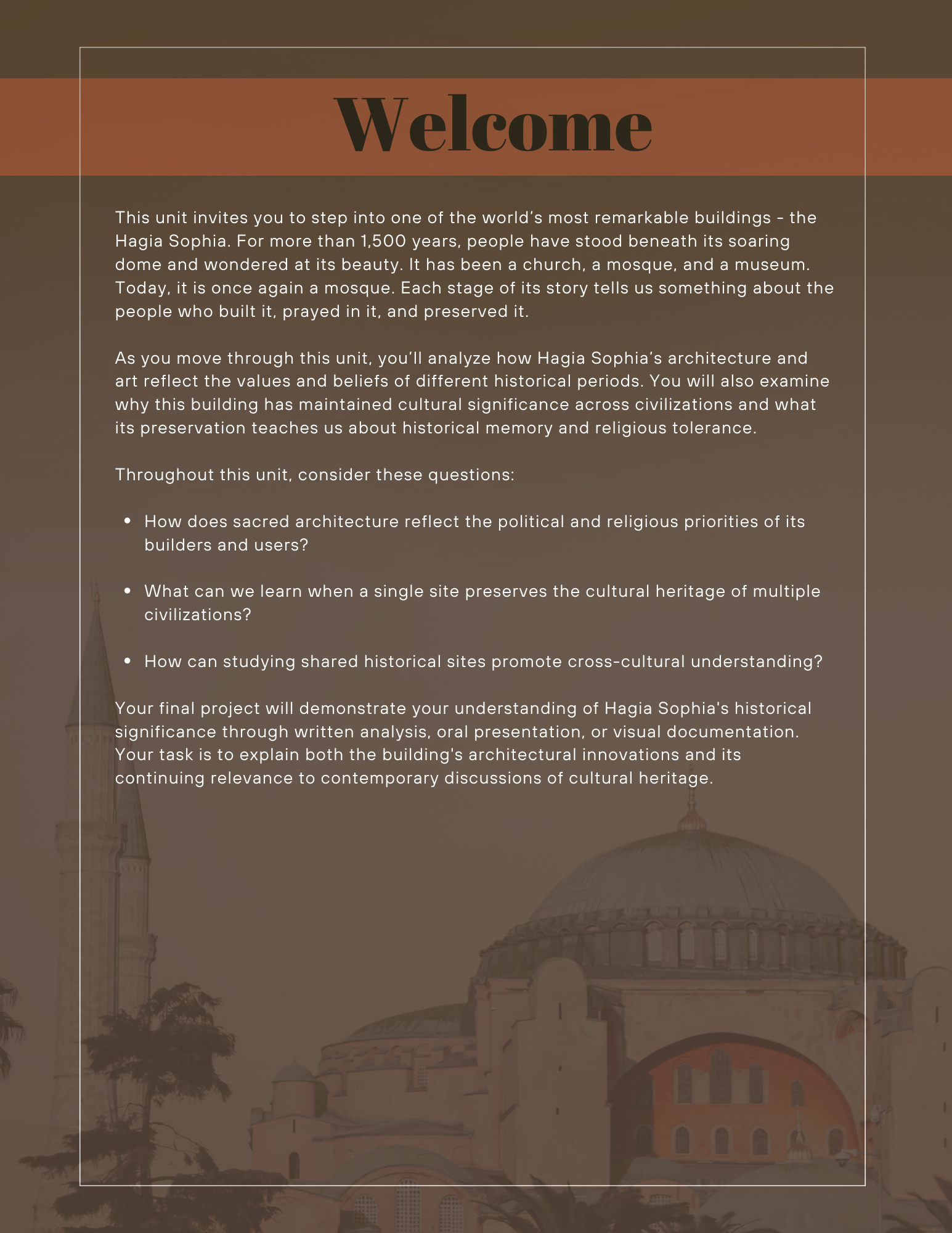
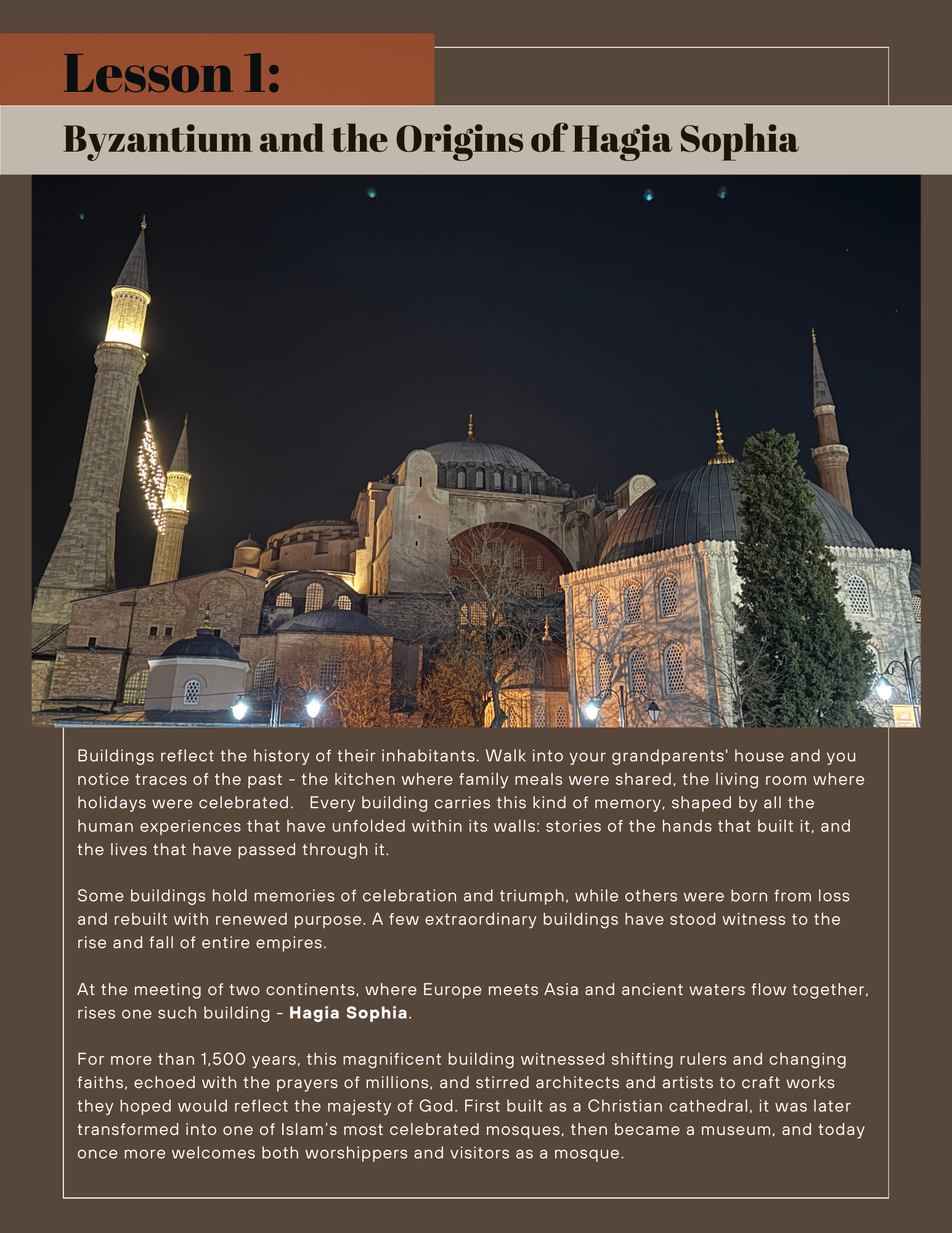
Student guide, Lesson 1 Byzantium and the origins of Hagia Sophia
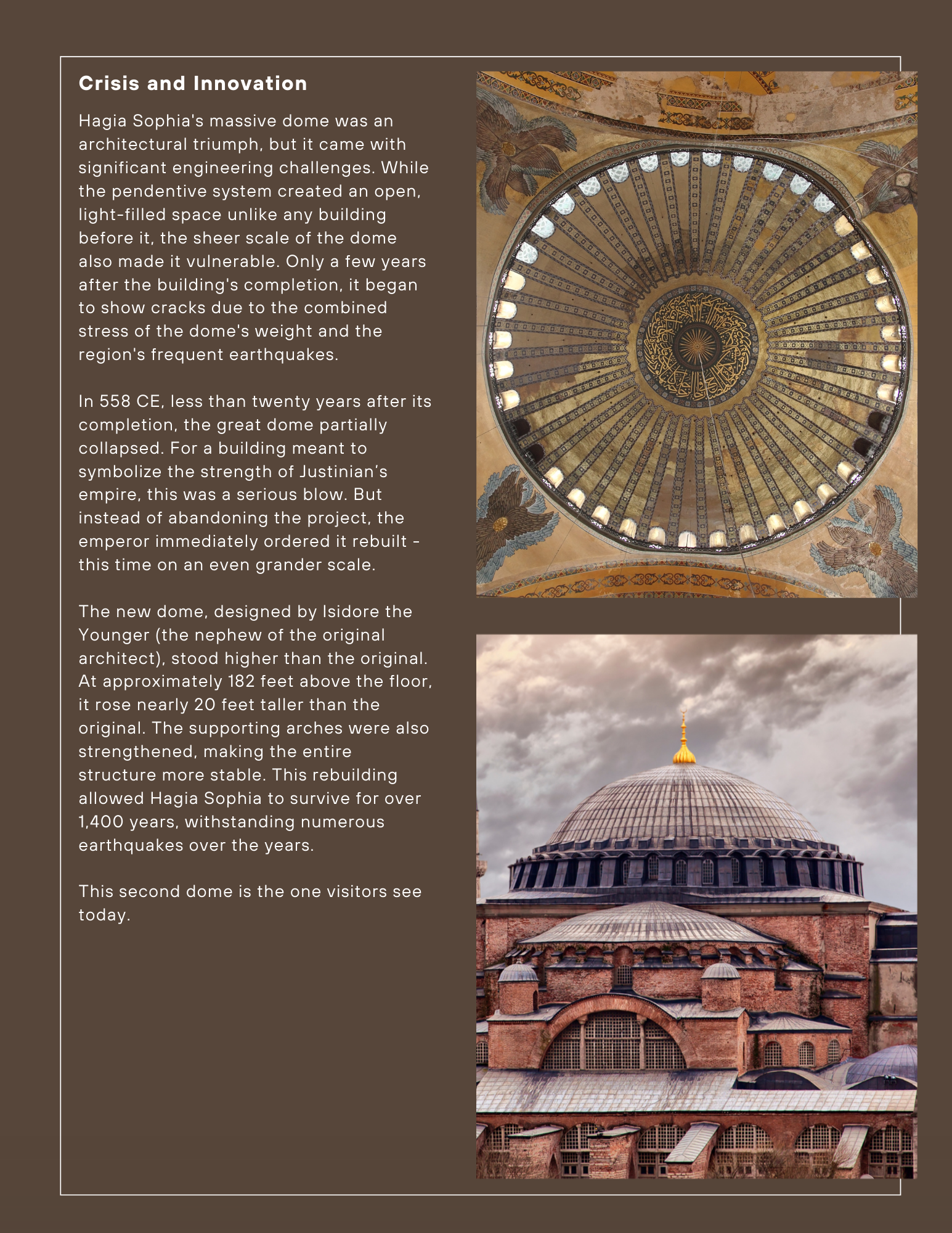
Student guide, Lesson 2 Hagia Sophia’s Byzantine Architecture and Art
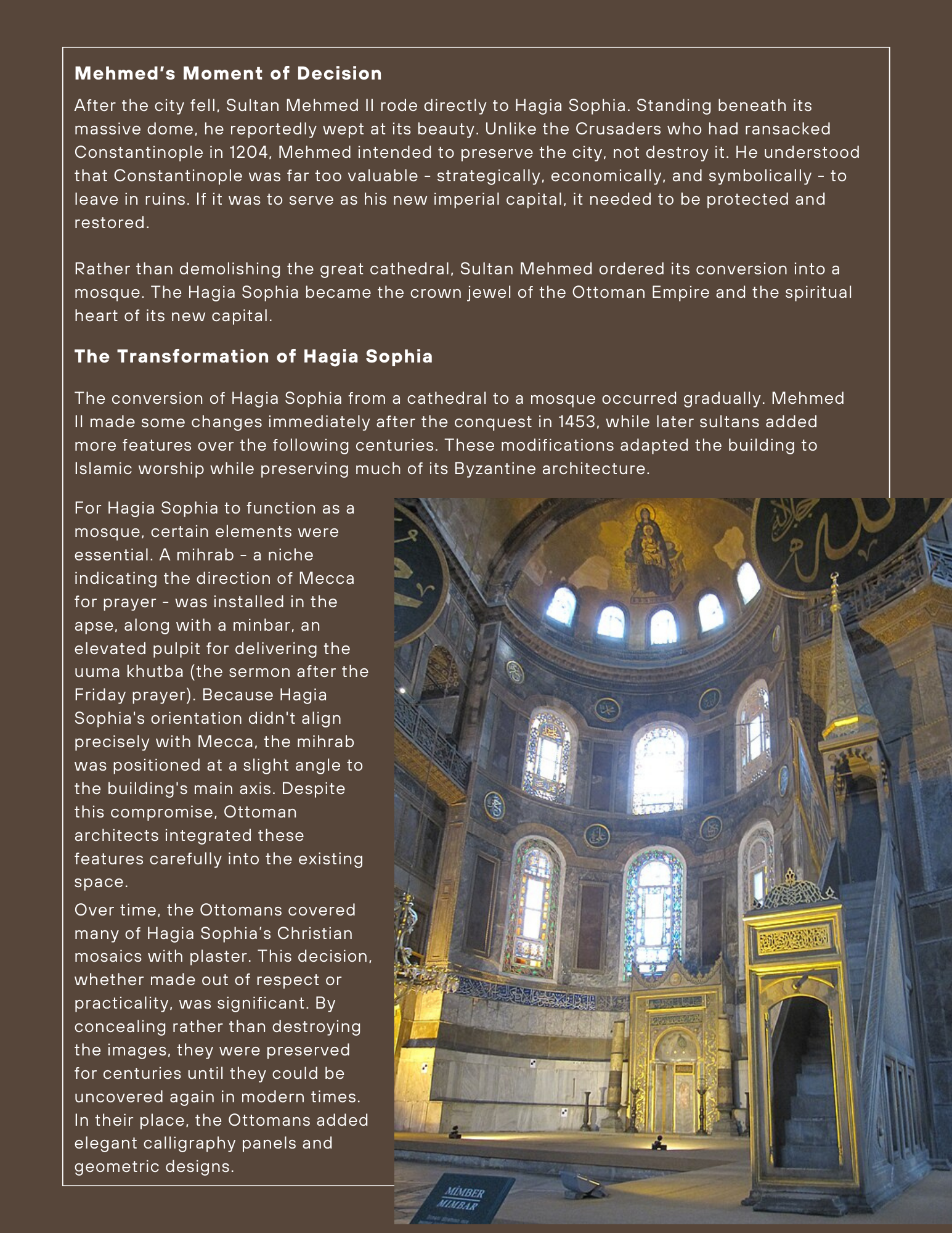
Student guide, Lesson 3 Hagia Sophia in the Middle Ages and Ottoman Era
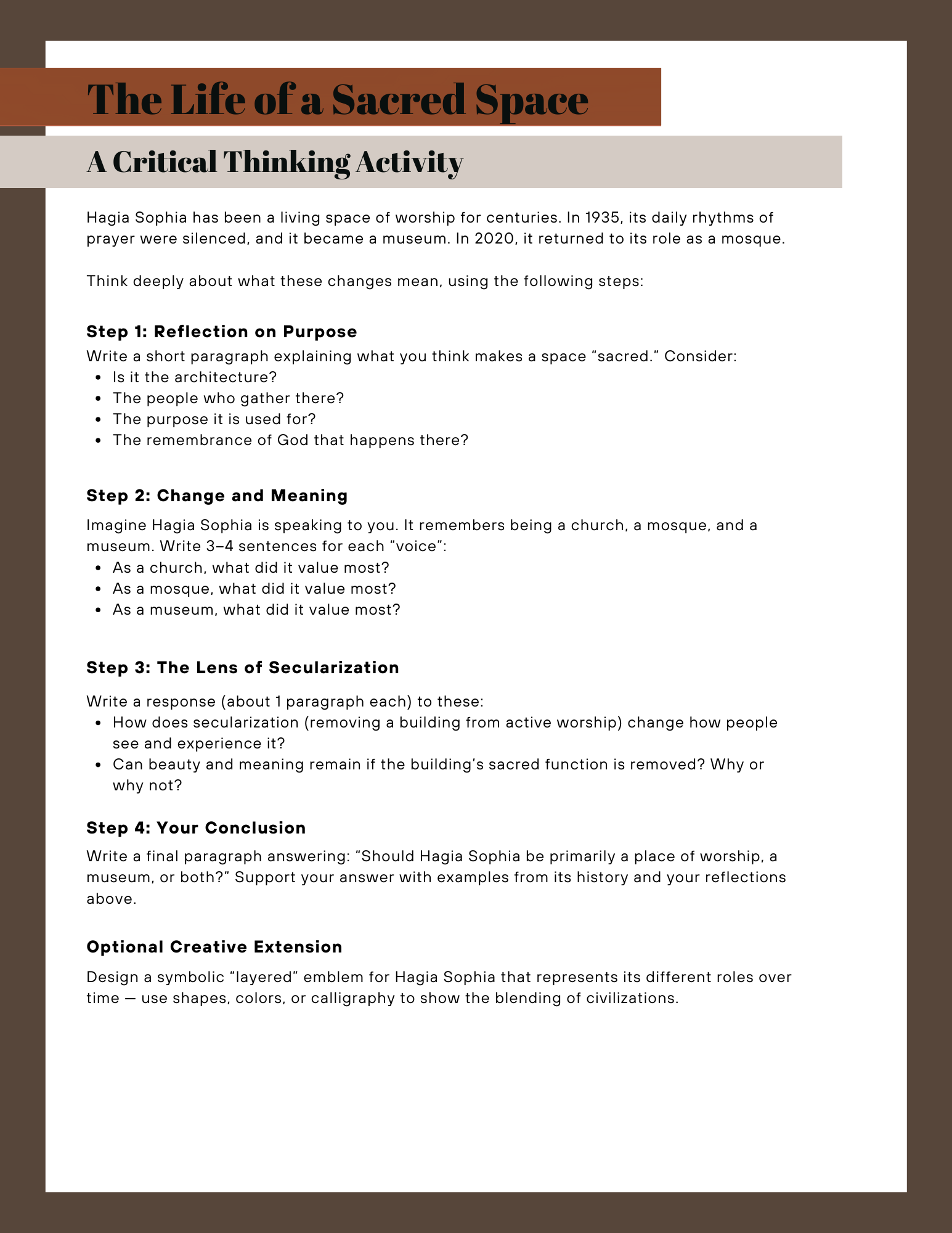
Student guide, Activity Page
What Makes This Study Unique
Most history resources mention Hagia Sophia once. This study spends five lessons inside it, moving through the people who built it, the empires that fought over it, the faiths that prayed in it, and the politics that still surround it today.
Students wrestle with:
Sacred space · Cultural inheritance · Empire and power · Secularization · Preservation vs. living worship